Introduction
Shifts in oil markets globally signal a transition toward a western economic revival happening quietly behind the scenes of world events. Politicians have a habit of jumping in front of a parade and taking credit for everything happening, and Donald Trump surely is leading the way around the world today, but the political and economic transformation occurring in the middle east and around the world today is a century in the making. Over many decades American military might has used regime change in the middle east as a means to eradicating the existing tribal power structures and propping up authoritarian central governments friendly to their aims.
As the military steps back, keeping positive pressure and control, diplomats and investment groups have stepped in to use those new governments as a means to a further end, which is the wholesale exploitation of resources coveted for a century. The political and economic transformation of the middle east signals a strategic victory for decades of American military adventures.
Transformation in the middle east is most apparent through observing the fall of three nations which have long opposed foreign interference, Iraq, Syria, and Lebanon. Over past decades they were warred against relentlessly. Now they each have US-backed governments bending over backwards to push the political and economic projects of US and allied nations forward. All three nations are now simultaneously seeking a monopoly on power through disempowering tribes and disarming militia groups within their borders, transforming once tribal-dominated lands into ones dominated by central governments supported and built by foreign powers. All three nations are working with Gulf Cooperation Council (GCC) (Saudi Arabia, Bahrain, the United Arab Emirates [UAE], Qatar, Oman, and Kuwait), European, and US investor groups to push through infrastructure and development projects such as oil pipelines and transportation corridors.
Wars, sanctions, and tariff scenarios have done much of the work to get here, but the capstone of the economic transformation of the middle east is brought about through the Hormuz Crisis. It has led to a sea change in the way oil is traded globally, making trade by sea so costly and uninsurable that the only effective alternative is to invest in land-based energy pathways. The crisis has strangled the economies of oil importers, causing them to ditch their green transitions and switch to buying from oil exporters which appear to be more stable, such as the US, Norway, and Nigeria.
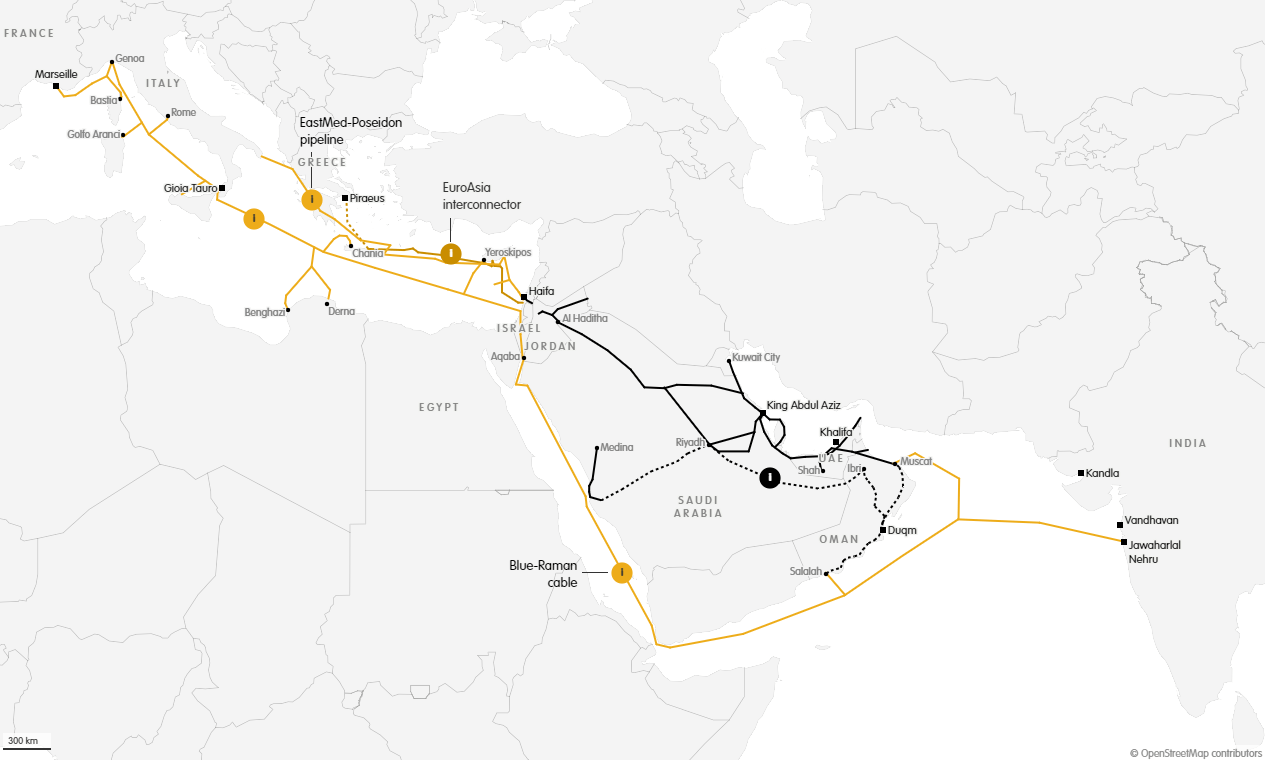
The US is expanding its domestic supply, production output, and export of oil and gas. The India Middle East Europe Corridor (IMEEC) project, based on an agreement signed at the G20 meeting in 2023, is being pushed forward with haste. Pipeline projects are being formalized to transfer oil and gas connecting India to the EU through the GCC nations, onward through Jordan, or Iraq, Syria, Israel, Lebanon, or Turkey to the EU. These political and economic outcomes will result in the dominance of oil companies and western nations and their allies for decades.
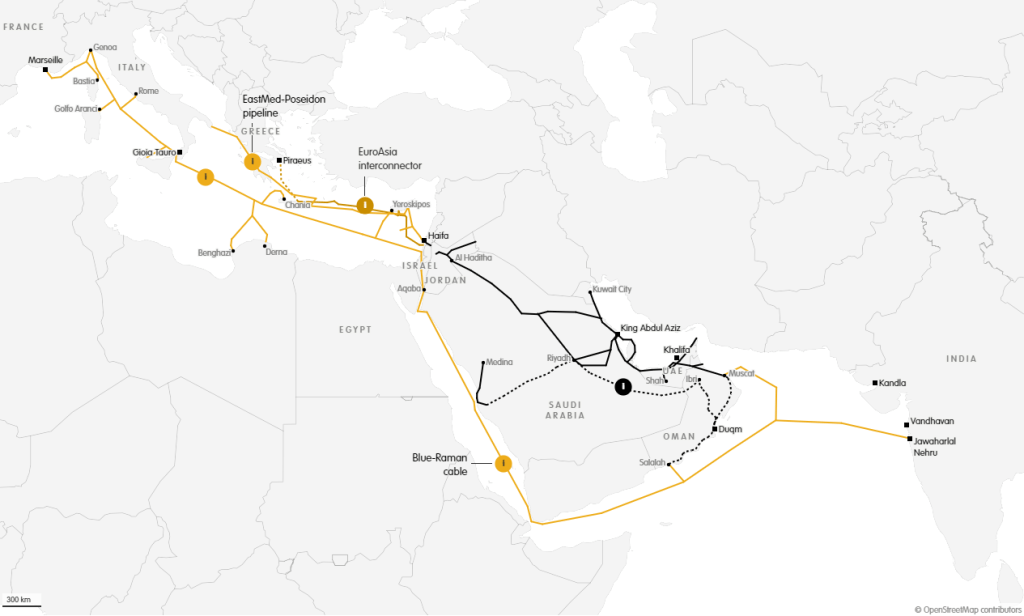
Map of the India Middle East Europe Corridor or IMEEC (Source: ECFR)
Regime Change’s Political Outcomes
Lebanon has long seen internal strife between Christians, Sunni and Shia Muslim cultures. Through division of the Shia community, and eradication of resisting factions, the central power of the state under the Christian majority is being cemented. The US and GCC nations have funded and equipped the government in Beirut which has resulted in a swing in power in favor of the central government and a sidelining of Shia power structures. While the Lebanese military sits on the sidelines Israel has waged relentless war on Shia culture south of the Litani River. The Beirut government has been pressured by the US and Israel to disarm Hezzbolah, and has had difficulty doing that, but recently has declared it will enact a state monopoly on weapons. The Lebanese military has pledged loyalty to the state after the US sanctioned some officers as well as members of the Shia political Amal movement. Lebanon is politically poised to purge Shia power and transition to a western-friendly state.
In Syria al-Assad was ousted by western-backed terrorists who have taken over the government, and the media has transformed the image of a terrorist with a US bounty on his head into a suit-wearing friendly president. Last year al-Sharaa enacted Syrian Investment Law 114 by presidential decree which opens investment to foreigners and grants full ownership rights, 80% tax breaks in perpetuity for export-oriented and priority industries, and protection from future costs after licensing kicks in. Sharaa will attend the G7 summit in mid-June to market Syria as a “potential strategic hub for supply chains” due to the Hormuz crisis. He wants Syria to become a hub for regional trade and an energy corridor. As I predicted years ago, the Kurds who bled to carve out a homeland for their people and facilitated the fall of Assad have been sidelined as they must now integrate into the nationstate where they will get only four of 210 seats in parliament. In February the Syrian President pledged to gain a monopoly on weapons for the central government.
The Iraq Wars led to the replacement of Saddam Hussein with a series of weak Baghdad governments which have been rather toothless in their ability to do what the US wants them to, but this month a very pro-US government has been formed led by Ali al-Zaidi. Like his Syrian and Lebanese counterparts, he quickly announced his intention to create a central government with a monopoly on arms, and to wipe out Iran-backed militias. He quickly has marginalized Shia politicians and Shia unity is collapsing, though they swear they will regroup. He seeks to develop missile defenses in the face of attacks alleged to have originated on Iraqi soil.
Economic Outcomes of Middle Eastern Wars
The Hormuz Crisis has sent shocks through global markets leaving nations to scramble to compensate. Global economic developments in the realm of trade and energy infrastructure have resulted in a big win for oil companies and western nations. The trade corridor connecting India to Europe through the Middle East takes center stage, but American developments are equally important. Developments in every other continent are just as important for their respective areas. While many of these projects are years in the making, the Iran situation has massively increased the economic incentive to push them forward.
India has grown into a major player on the world scene. With a burgeoning population and growing economy it seeks to expand its economic connections with the world. India liquidated its commitment to the Chabahar Port project in January, which would have given it an economic corridor to Afghanistan through Iran, after Trump’s prolonged tariff campaign. Iran recently tried to revive the project, but India’s new strategic partnership with Italy signals the IMEEC project will move forward instead. Meanwhile, India plans to drill for oil off its own shores. Indonesia pledged fair oil and gas investments, signed 8 new blocks and announced over 100 more. Malaysia, Vietnam, and Papua New Guinea are starting oil drilling projects as well.
An American oil boom was initiated by Donald Trump when he passed the 2025 Big Beautiful Bill which among other things slashed oil regulations, enabled tax loopholes for oil companies, gave them subsidies and loans, and defunded alternative energy projects. Since the effects of the Hormuz crisis have made oil drilling more profitable, projects have been announced all over the US. US gas exports doubled within weeks of the Iran war starting, with many allies increasing or switching to US exports. Enbridge, now the world’s largest oil and gas pipeline company, seeks to cash in on the Iran war to drive stable American exports. An oil industry conference in Bismarck, North Dakota revealed plans to double North Dakota oil output, and Governor Burgum flipped on carbon neutrality to endorse big oil, AI, and data centers, calling the Iran war a “gift.” The Arizona Bureau of Land Management proposes oil exploration leases in the north of the state. New Mexico, the second biggest oil producing state next to Texas, is raking in millions while pretending not to be happy about it to soothe its progressive voter base, and together with Texas will make 4 billion off selling drilling rights. Alaska has opened up thousands of acres to oil drilling, its governor says Iran war is Alaska’s chance, and the Pikka project is set to make billions for the state over its lifetime. The Canadian PM recently signed a carbon pricing MOU with Alberta, opening a path for an Alberta to BC pipeline, reassuring critics it will benefit BC.
The EU has cut its growth forecast as fears of stagflation rise. The UK cut tariffs on GCC goods and agreed to a $5B per year trade deal with the GCC, despite previous concern about human rights violations. The Israeli oil company Ithaca has surged operations off the UK’s Shetland Islands. Norway has boosted its oil output and seeks to replace Russia as supplier to Europe. Despite gloomy skies, the promise of the IMEEC project gives Europe a potentially brighter future outlook.
Africa is feeling the squeeze due to the Iran war, with some nations resorting to fuel rationing and seeking oil supplies from places other than the Middle East. The horn of Africa is teetering on the edge of a humanitarian disaster. Nigeria meanwhile is boosting its output and cashing in on high oil prices
Oceanian is heavily dependent on sea- and air-based trade. New Zealand is in crisis mode and braces for spiked oil prices, inflation, and fuel rationing, while they and surrounding islands have asked the US to deliver oil to them. Australia’s populist party proposed a Norway-style state oil company and oil fund at an oil conference.
South America is expected to see an increase in new drilling projects this year. Brazil has doubled its oil exports to China in the first quarter of this year, and Lula claims new drilling at the Amazon river mouth basin can be done responsibly. Argentina expects nearly double output within five years, and will open a new Atlantic terminal later this year. Venezuelan crude imported by the US is expected to bring down US prices at the gas pump.
GCC pipelines now carry ten times more oil than before the war and pipeline building has surged there. Saudi Arabia and Pakistan, which signed a mutual defense pact last September, are set to renew oil investments and trading. Bahrain has sought JP Morgan and international investors for new energy projects. While the IMEEC project faced uncertainty in January, due to the Hormuz crisis it has a greater chance to turn the Middle East into “West Asia.”
Lebanon’s central bank has bought $5 billion in US debt, and will connect Tripoli to Syria by rail. The nation is in discussion for railways from Saudi Arabia through Jordan, Syria, and Turkey. After the landmark deal to demarcate maritime boundaries with Israel in 2022, French and Qatari oil exploration offshore in Lebanon’s Block 9 flopped, but these companies have doubled down in exploration of Block 8 this January. In November 2025 Lebanon signed another demarcation deal with Cyprus and Greece, enabling further energy exploration. Syria and Lebanon’s leaders met this month to establish a new framework in relations regarding cooperation “on economy, energy, transportation, and security.”
Syria will link Adra (near Damascus) and Latakia (on the coast) by train, and give a french company operation and management of two dry ports. French, Qatari, and US oil companies recently announced a deal signed with Syria’s national oil company to explore off the coast. At times, 400 trucks per day, from GCC nations and Iraq now carry oil through Syria to Mediterranean ports to bypass the Hormuz situation. Syrian Petroleum Company and Chevron will soon begin developing an offshore oil block this summer. A Bahrain telecoms operator Zain wants to develop infrastructure around Syria. Syrian talks with a US engineering group about road and rail projects plan to keep products flowing through the country. The US has released an investment report on Syria encouraging investment in gas, oil, and electricity projects. Over 120 UAE companies lined up at a conference recently to invest in Syria. A wealthy UAE citizen plans to invest billions in Syrian real estate projects as the new Syria-UAE Business Council opens development opportunities including in energy projects. Japan has granted millions to Syria through the UN to develop the Syrian civil sector, and to add stability to the energy sector. Syria “in cooperation with partners” will fix the Raqqa oil field and develop Jazira fields for oil extraction. The EU has pledged hundreds of millions in a renewed trade partnership with Syria for development and security.
Iraq exports of oil were $90 billion last year, and as the 2nd largest OPEC producer most of its exports are oil. Most of its oil went through the Hormuz Straight. Iraq exports of oil have now shifted to the Kirkuk-Ceyhan (Kurdish Region to Turkey) pipeline due to the Hormuz Crisis. Iraq is trucking oil from Basra in the south to the Kurdish pipeline. Iraq seeks to export oil to Jordan. The IEA executive director Birol calls for building of a Basra-Ceyhan pipeline and Iraq’s Basrah-Haditha oil pipeline is being built to transport oil to Jordan, Syria, and Turkey. The UN Secretary General looks forward to economic development in Iraq, as the UNDP funds Iraqi investment projects. The Baghdad government seeks to bypass the Kurdistan region with an economic corridor called the Development Road Project from the GCC, through Iraq and Turkey, to the EU, with negotiations happening for a Jordan branch. A Chinese company Zenhua is exploring a massive new oil deposit along SW Iraq’s Saudi border. China’s Norinco Group has struck oil in its blocks along the Saudi border, as part of Iraq efforts to increase output to 6 million bpd by 2029. The Iraq national Basra Oil Company may default on its payments to a large oil project in Basra, but partners TotalEnergies and QatarEnergies are in contract with a Chinese company to complete various other projects.
Conclusion
Wars always have economic reasons for being waged. Militaries generally tend to destroy existing power structures, install governments friendly to preferred partners, and facilitate the opening of new markets for foreign exploitation. The Middle East has undergone an amazing transformation over the past few decades, with America leading the way and sharing in the spoils with European, Gulf, and other allies such as India and Japan. This facilitates a greater strategy of competing with China and Russia, but full military victory is not necessary so long as decades of prosperity can be garnered. So, with recent developments in the Middle East, it appears Donald Trump is on the verge of a minor strategic victory in the Iran War. He may seek major strategic victory conditions but I don’t expect any unrestrained escalations to world war. After all that would hurt the progress of all of these economic developments which took decades to put into motion. If he negotiates peace soon he can do what all politicians do, and take credit for everything despite coming in at the end and finishing what others started.


